How Long Does It Take for a Herniated Disc to Heal?

If you have just been told you have a herniated disc, this is likely your first question. The honest answer is that it varies, but it is usually better news than people fear. Many herniated discs improve on their own over weeks to months, and a large share shrink on imaging. Some do not, and some situations should not wait.
This post explains what "healing" means for a disc, what the research shows about typical timelines, what affects recovery, when to see a surgeon or physician, and how we approach it at Loop Spine & Sports Center.

First, What Does "Heal" Mean?
When people ask whether a herniated disc will heal, they usually mean one of two things, and they follow different timelines:
Your symptoms settling down. This is pain, leg symptoms, numbness, or tingling easing enough that you are back to normal life.
The disc itself changing. This is the herniated material shrinking or being reabsorbed by the body, which shows up on an MRI.
The two do not always move together. Symptoms often improve before the disc visibly changes, and some people have herniations on imaging with little or no pain. That is why a scan alone does not tell you how you will feel, and why treatment decisions should rest on your symptoms and exam, not only on the picture. Our herniated discs page explains what a herniated disc is, and our post on herniated disc vs. muscle strain helps you tell them apart.
What the Research Shows About Typical Timelines
Symptoms: Weeks to a Few Months
A clinical review of acute lumbar disc pain in American Family Physician reports that for about 90 percent of patients, acute sciatica starts to improve within six weeks and resolves by about 12 weeks with conservative care. It also notes that large herniations typically reabsorb over time. That is one review's summary, and individual recovery varies, but it is a useful benchmark: improvement in the first six weeks is common, and many people are largely better by around three months.
A well-known randomized trial in the New England Journal of Medicine (Peul et al., 2007) points the same way. In people with severe sciatica for 6 to 12 weeks, those assigned to prolonged conservative care and those assigned to early surgery had similar perceived recovery at one year, though surgery brought relief faster. About 61 percent of the conservative group never needed surgery.
The Disc Itself: Often Within Six Months
A 2024 meta-analysis in Clinical Spine Surgery pooled 31 studies and 2,233 patients who received conservative treatment. Overall, about 70 percent showed spontaneous resorption of the herniated material. The rate depended heavily on the type of herniation:
Sequestration (a fragment that has separated from the disc): about 88 percent
Extrusion: about 67 percent
Protrusion: about 38 percent
Bulge: about 13 percent
The authors concluded that most resorption occurred within six months. The counterintuitive point is that the more dramatic-looking herniations, the ones that break through the disc wall, are more likely to shrink than contained ones. Rates also varied widely between countries, which the authors could not fully explain, so treat the percentages as a rough guide, not a prediction for any one person.
A Realistic Timeline
Putting those findings together, a typical course for an acute disc herniation without red flags looks something like this. These are general patterns, not promises:
First 6 weeks: The most painful phase. Many people start improving in this window.
6 to 12 weeks: A large share of people with sciatica are mostly better by the end of this period.
3 to 6 months: Much of the resorption seen on imaging happens here, and residual symptoms often continue to fade.
Beyond 6 months: Persistent symptoms are less typical and deserve a closer look, including a discussion of other options.
What Affects Recovery
Not every herniated disc follows the average. Factors that influence the course include:
Type and size of the herniation. As the numbers above show, larger and more extruded herniations are more likely to shrink than small contained ones.
Which nerve is involved and how severely. Significant weakness or loss of reflexes changes the plan.
How long symptoms have been present. Problems that persist past the usual window need a re-evaluation.
Your demands and habits. Long hours of sitting, heavy lifting, and workstation setup all matter, especially for desk workers in the Loop. See our posts on desk work and back and neck pain and the Chicago Loop worker's guide to low back pain.
Does Chiropractic Care Speed Healing?
We want to be careful here. The research does not show that any non-surgical care makes a disc itself heal faster. What care can reasonably aim to do is help you stay more comfortable and functional while your body does what it tends to do on its own. For some people, that matters a great deal, because the first weeks are the hardest.
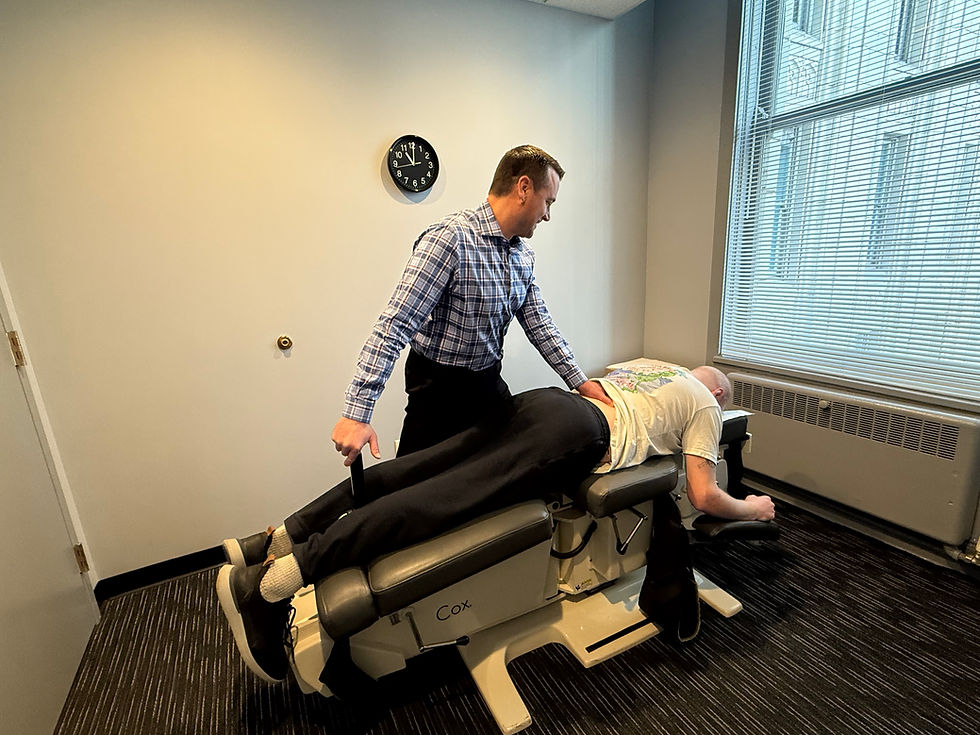
At our office, that may include flexion distraction or spinal decompression therapy for appropriate candidates, chiropractic adjustments chosen to fit your exam, and supportive options such as electrical stimulation therapy, therapeutic ultrasound, and massage therapy. Our post on who is a good candidate for spinal decompression explains how that decision is made. We do not offer physical therapy or a rehab exercise program, so when you need a structured one, we will point you to a physical therapist.
Staying gently active within what your pain allows is generally advised over prolonged bed rest. What counts as the right amount of activity depends on your case, which is part of what the exam is for.
When to Stop Waiting and Get Evaluated Further
Urgent: Do Not Wait
Go to the emergency room for loss of bladder or bowel control, numbness in the groin or inner thighs (saddle numbness), or rapidly worsening leg weakness. These can signal cauda equina syndrome, which needs emergency care. Other warning signs that need a physician first include fever, unexplained weight loss, a history of cancer, and pain after significant trauma. Our post on red flags in chiropractic care covers them.
Not Improving: Around Six Weeks
The same clinical review recommends considering imaging if there is no improvement after about six weeks of conservative care, and notes that surgery is an option for people with persistent weakness or severe sciatica that matches the imaging. It also notes that surgery tends to speed relief, but outcomes were no different from conservative care at two years.
That is why we build a review point into every plan. If you are not improving as expected, the plan changes or you are referred for imaging or a surgical opinion. Our posts on spinal decompression vs. surgery and whether chiropractic care can prevent back surgery go deeper on that decision.
Will It Come Back?
It can. A disc that has settled is not immune to future strain, especially if the habits that contributed are unchanged. Breaking up long periods of sitting, lifting carefully, and keeping active are sensible steps, though no habit guarantees it will not recur. Disc-related problems also overlap with other spine conditions. See our pages on sciatica, degenerated discs, and low back pain, and our post on low back pain vs. sciatica.
What to Expect From an Evaluation
An evaluation starts with your history and a hands-on exam, plus digital X-rays if needed, and ends with a plain explanation of what we find and what we recommend. If you have never visited a chiropractor, our post on what to expect at your first chiropractic appointment walks through it. You can learn more about Dr. Trottier on the Dr. Ron Trottier page, review our frequently asked questions, or contact the office with questions before booking.
Sources
Acute lumbar disk pain: navigating evaluation and treatment choices. Am Fam Physician. 2008;78(7):835-842.
Incidence of spontaneous resorption of lumbar disc herniation: a meta-analysis. Clin Spine Surg. 2024;37(6):256-269.
Peul WC, et al. Surgery versus prolonged conservative treatment for sciatica. N Engl J Med. 2007;356(22):2245-2256.
Ready to Get Evaluated?
If you have been told you have a herniated disc, or you have back and leg symptoms that are not clearing, an evaluation can help you understand where you stand and what to expect.
New patients can take advantage of our $75 first visit special, which includes a thorough consultation, complete spinal examination, digital X-rays if needed, and a report of findings.
Mention this offer when you call, text, or book online to receive the special rate. No pressure, no obligation. Just an honest conversation about what is going on and whether we can help.
Patients using insurance will be billed according to their plan's fee schedule. Copays, coinsurance, and deductible amounts may apply.