

Can Chiropractic Care Prevent Back Surgery?

If you have been told your back or leg pain might end in surgery, this is probably the question on your mind. Search for it and you will find confident answers in both directions: chiropractors who say care can help you avoid the operating room, and critics who say it only delays the inevitable. The research supports a more careful answer than either.
This post goes through what the evidence shows about conservative care and surgery for the back problems most likely to raise the question: disc herniation with sciatica, low back pain, and spinal stenosis. It also covers when surgery is the right call and when it is not. At Loop Spine & Sports Center, part of Dr. Trottier's job is helping patients tell the difference.
The Short Answer
Chiropractic care cannot promise to prevent surgery, and no honest provider should. What the research does support is narrower and still useful: for many people with back pain and sciatica who do not have urgent warning signs, trying well-chosen conservative care first is reasonable, and a good share of them improve without an operation. Others do end up needing surgery, and some should go to a surgeon sooner. The goal of an evaluation is to work out which group you are in.
What the Research Shows
Guidelines Put Conservative Care First for Most Back Pain
The American College of Physicians published low back pain guidelines in Annals of Internal Medicine in 2017. For acute and subacute low back pain without leg symptoms, they recommend starting with non-drug approaches such as superficial heat, massage, acupuncture, or spinal manipulation.
For chronic low back pain, they recommend starting with options such as exercise, spinal manipulation, acupuncture, yoga, tai chi, and cognitive behavioral therapy. The guideline made no recommendation for back pain with leg pain from a pinched nerve (radicular pain), citing insufficient evidence.
That is a meaningful point: for most common back pain, mainstream medical guidance already puts conservative care ahead of drugs and procedures. It is not specific to chiropractic, and it does not say conservative care prevents surgery. It does say surgery is not where most people should start.
Sciatica From a Disc: Many Improve Without Surgery, Surgery Often Works Faster
A well-known 2007 randomized trial in the New England Journal of Medicine (Peul et al.) compared early surgery with prolonged conservative care in 283 patients with severe sciatica lasting 6 to 12 weeks. The findings were mixed in a useful way:
Early surgery brought faster pain relief and faster perceived recovery.
By one year, perceived recovery was about the same in both groups (95%), and disability scores did not differ significantly.
Of the patients assigned to conservative care, 39% (55 of 142) ended up having surgery within the study period. The other 61% recovered without it.
That trial studied conservative care in general, not chiropractic specifically. But it shows what most sciatica research shows: waiting is a defensible choice for many people, but it is not a guarantee, and surgery tends to relieve leg pain sooner for those who need it.
Spinal Manipulation Compared With Surgery for Sciatica: Promising but Small
A 2010 pilot study in the Journal of Manipulative and Physiological Therapeutics (McMorland et al.) randomized 40 patients with disc-related sciatica, all referred to neurosurgical spine surgeons after at least three months of failed non-surgical care, to either spinal manipulation or microdiscectomy.
At one year, about 60% of the patients in the manipulation group had improved to the same degree as surgery patients. The rest did not respond well to manipulation, and patients who then crossed over to surgery improved as much as those who had surgery first. The authors suggested manipulation as a reasonable step before surgery for this group.
The honest caveats matter here. It was a small study with no group receiving no treatment, and the follow-up was under two years. It is encouraging evidence, not proof.
A Large Observational Study Found Fewer Discectomies
A 2022 study in BMJ Open used a large health records network to compare adults aged 18 to 49 with disc herniation or sciatica who began with chiropractic spinal manipulation against a matched group who received other medical care. Each group had 5,785 patients. At one year, 1.5% of the chiropractic group had a discectomy compared with 2.2% of the comparison group; at two years, the figures were 1.9% and 2.4%. The authors described the chiropractic group as significantly less likely to have the surgery.
This is an observational study, so it cannot show that chiropractic care caused the difference, and the authors called for a randomized trial. The absolute numbers are small, too. Still, it points in the same direction as the other evidence: for this kind of patient, starting with chiropractic care was not associated with more surgery, and was associated with somewhat less.
Spinal Stenosis: Surgery Helps, and the Advantage Can Fade
Spinal stenosis is where surgery has its strongest case. In the long-running SPORT trial, 8-year results published in Spine in 2015 (Lurie et al.) showed that the early advantage of surgery narrowed over time in the randomized as-treated analysis, with no significant difference in years 6 to 8, while the observational cohort kept a stable advantage.
By year 8, about half of those assigned to non-surgical care had undergone surgery. In other words, many people with stenosis eventually choose an operation, and those who do often benefit.
Conservative care is a reasonable first step for many, not a substitute for surgery in every case. Our post on lumbar spinal stenosis covers this condition in more detail.
When Surgery Is the Right Call
Some situations should not wait for a trial of conservative care. Get urgent medical attention for:
Loss of bladder or bowel control, or numbness in the groin or inner thighs
Progressive leg weakness, or a foot that starts to drag or slap
Severe pain that is rapidly worsening and not responding to anything
Back pain with fever, unexplained weight loss, or a history of cancer
Pain after significant trauma
These signs can indicate serious nerve compression or other conditions that need a physician, and sometimes a surgeon, right away. Our post on red flags in chiropractic care covers more of them. A responsible chiropractor will send you to the right place quickly when they see them. We are a solo chiropractic practice, and we do not perform or schedule surgery.
How We Approach It at Loop Spine & Sports Center
The starting point is an evaluation, not a promise. Dr. Trottier takes a history, performs a hands-on exam, takes digital X-rays if needed, and sorts out whether your problem looks like a mechanical issue, a disc problem, nerve irritation, or something that needs medical workup first. You can learn more about his background on the Dr. Ron Trottier page.
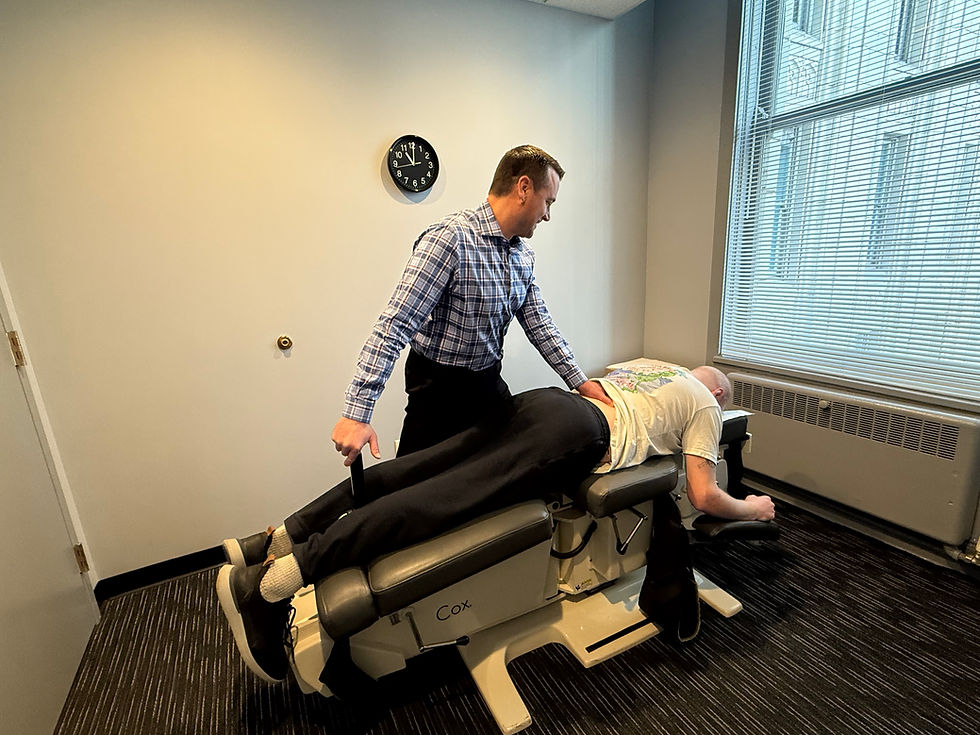
If conservative care fits, the plan may include chiropractic adjustments, flexion distraction, or, for appropriate candidates, spinal decompression therapy. Our post on who is a good candidate for spinal decompression explains how that decision is made, and our comparison of spinal decompression vs. surgery goes deeper on the surgical side.
Every plan has a defined purpose and a point at which it is reviewed. If you are improving, care continues or tapers. If you are not improving as expected, or your symptoms change, the plan changes and we refer you for further evaluation, including a surgical opinion when that is appropriate. Getting a second opinion before any operation is always reasonable, and conservative care before surgery does not close that door.
Questions Worth Asking Before You Decide
What is causing my symptoms, and how do you know?
Are there any signs that make waiting risky?
What improvement should I expect, and by when?
What will we do if I am not better by then?
If surgery is recommended, what does the operation involve, and what are the alternatives?
To understand your condition better first, see our pages on herniated discs, sciatica, degenerated discs, and low back pain, along with our posts on low back pain vs. sciatica, herniated disc vs. muscle strain, and when to see a chiropractor for low back pain. If you have never been to a chiropractor, what to expect at your first chiropractic appointment walks through the visit.
The Bottom Line
Chiropractic care may help some people avoid or delay surgery, particularly those with disc-related sciatica and common low back pain who have no red flags, and the available research is encouraging but not conclusive. It does not replace surgery when surgery is needed, and it should never delay an urgent evaluation. The best outcome comes from an honest assessment, a defined trial of conservative care when appropriate, and a quick handoff when it is not.
Sources
Qaseem A, et al. Noninvasive treatments for acute, subacute, and chronic low back pain: a clinical practice guideline from the American College of Physicians. Ann Intern Med. 2017.
Peul WC, et al. Surgery versus prolonged conservative treatment for sciatica. N Engl J Med. 2007;356(22):2245-2256.
McMorland G, et al. Manipulation or microdiskectomy for sciatica? A prospective randomized clinical study. J Manipulative Physiol Ther. 2010;33(8):576-584.
Trager RJ, et al. Association between chiropractic spinal manipulation and lumbar discectomy in adults with lumbar disc herniation and radiculopathy: retrospective cohort study using TriNetX. BMJ Open. 2022;12:e068262.
Lurie JD, et al. Long-term outcomes of lumbar spinal stenosis: eight-year results of the Spine Patient Outcomes Research Trial (SPORT). Spine. 2015;40(2):63-76.
Ready to Get Evaluated?
If you are facing the question of surgery, or trying to avoid it, an evaluation can clarify where you stand. You can review our frequently asked questions or contact the office with questions before booking.
New patients can take advantage of our $75 first visit special, which includes a thorough consultation, complete spinal examination, digital X-rays if needed, and a report of findings.
Mention this offer when you call, text, or book online to receive the special rate. No pressure, no obligation. Just an honest conversation about what is going on and whether we can help.
Patients using insurance will be billed according to their plan's fee schedule. Copays, coinsurance, and deductible amounts may apply.


