Herniated Disc vs. Muscle Strain: What Your Symptoms Are Telling You
When your back goes out, the first question most people ask is: what just happened? Two of the most common answers are a herniated disc and a muscle strain, and while both can cause significant low back pain, they are fundamentally different problems that respond best to different treatment approaches. Knowing which one you are dealing with can help you make better decisions about your care and avoid spending time on treatment that is not well matched to what is actually going on.
Dr. Ron Trottier has been evaluating and treating both conditions at Loop Spine & Sports Center in downtown Chicago since 2000. Here is how to think about what your symptoms might be telling you.

What Is a Muscle Strain?
A muscle strain is an injury to a muscle or its tendon, the connective tissue that attaches muscle to bone. In the low back, strains most commonly involve the large paraspinal muscles that run along either side of the spine, the muscles of the lower back that support posture and movement throughout the day. A strain occurs when those muscles are overstretched or overloaded, either from a sudden movement like lifting something heavy in an awkward position, or from the gradual accumulation of repetitive stress over time.
Muscle strains can range from mild tension and soreness to significant pain that makes it difficult to stand, walk, or change positions. The key characteristic of a muscle strain is that the pain is local and muscular in nature. It tends to be concentrated in the lower back and possibly the upper buttock, it is often worse with movement and better with rest, and it does not produce neurological symptoms like numbness, tingling, or weakness in the legs.
What Is a Herniated Disc?
The discs of the lumbar spine sit between the vertebrae and serve as shock absorbers. Each disc has a tough outer layer called the annulus fibrosus and a soft gel-like center called the nucleus pulposus. A herniation occurs when the outer layer develops a tear or weakness and the inner material pushes through, pressing against the surrounding nerve tissue.
A herniated disc can cause significant local low back pain, but what distinguishes it from a muscle strain is the potential for neurological symptoms. When the herniated material presses on a nerve root as it exits the spine, the result is radiating pain, numbness, tingling, or weakness that travels from the lower back down through the buttock and leg in the pattern known as sciatica. The location and character of the radiating symptoms depends on which disc is herniated and which nerve root is affected.
How to Tell the Difference
The clearest distinguishing factor between a muscle strain and a herniated disc is whether neurological symptoms are present. If your pain stays in your lower back and possibly your upper buttock without traveling down your leg, and if you have no numbness, tingling, or weakness in your legs or feet, a muscle strain is a reasonable possibility. If you are experiencing any radiating symptoms down your leg, those are neurological in nature and suggest disc or nerve involvement rather than a simple muscle injury.
A few other patterns are worth paying attention to. Muscle strains tend to improve relatively quickly with rest, gentle movement, and proper treatment. They are often worse immediately after the injury and gradually improve over days to weeks. Herniated discs can also improve with conservative care, but they tend to be more persistent and more sensitive to specific positions and movements. Sitting for extended periods often aggravates disc-related symptoms in particular, which is relevant for the large number of desk workers who come into Loop Spine & Sports Center with low back complaints.
The position that makes the pain worse is also a useful clue. Muscle strains are often aggravated by movement in multiple directions. Disc herniations frequently have a more specific pattern, with symptoms worsening in certain positions and improving in others, depending on how the herniated material is pressing on the nerve.
Why Getting the Diagnosis Right Matters
A muscle strain and a herniated disc both cause low back pain, but they are treated differently. A muscle strain responds primarily to soft tissue treatment, rest, and restoring normal movement patterns. Massage therapy targeting the injured musculature combined with chiropractic adjusting to restore proper joint mechanics is the most effective approach for most muscle strains.
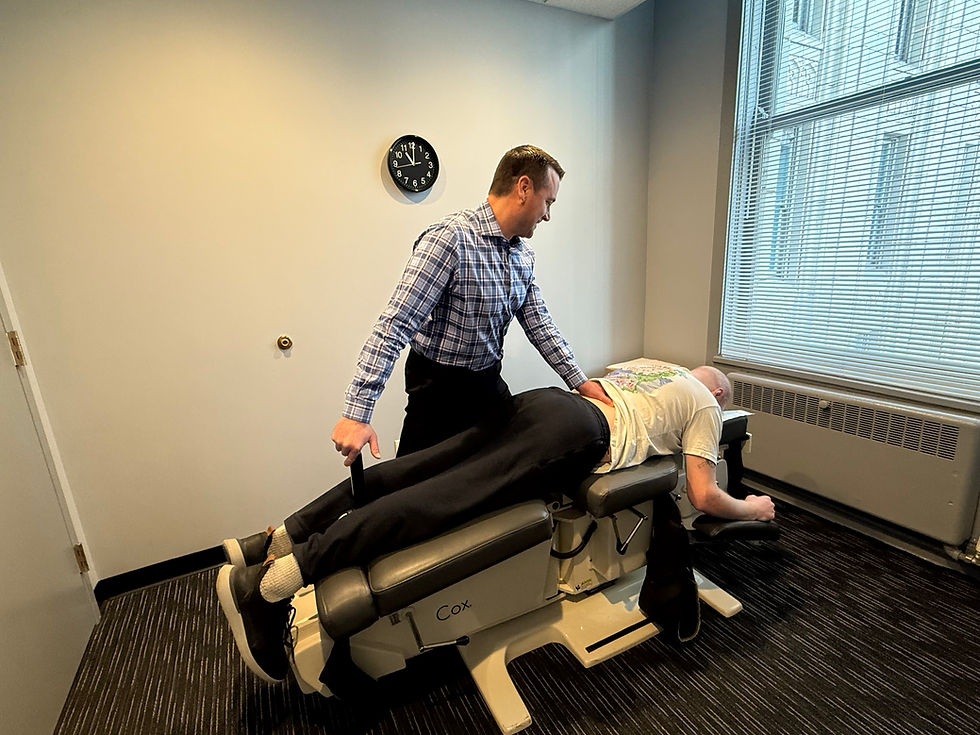
A herniated disc requires a more targeted approach that addresses the disc itself alongside the surrounding soft tissue and joint dysfunction. Spinal decompression therapy is one of the most effective non-surgical treatments for herniated discs, creating negative pressure within the disc that can help retract herniated material away from the nerve and support healing. Flexion distraction is another technique specifically suited to disc conditions, applying a gentle controlled decompression force to the lumbar spine without forceful manipulation.
Treating a herniated disc the same way you would treat a muscle strain is unlikely to produce good results. And treating a muscle strain with the aggressive disc-focused protocols appropriate for a herniation is unnecessary and potentially counterproductive. Getting the diagnosis right before treatment begins is not an optional step. It is what determines whether care actually works.
Can You Have Both at the Same Time?
Yes, and it is actually quite common. A sudden disc herniation is often accompanied by significant muscle spasm in the surrounding musculature as the body attempts to protect the injured area.
Long-standing disc problems frequently produce chronic muscle tension and trigger points in the paraspinal muscles that become a significant source of pain in their own right. In these cases, effective treatment addresses both the disc component and the muscular component simultaneously rather than focusing exclusively on one or the other.
When to Stop Waiting and Get Evaluated
If you have low back pain that is not improving after a week or two of rest and over-the-counter pain management, it is worth getting a proper examination rather than continuing to guess. If you have any radiating leg symptoms, numbness, tingling, or weakness at all, do not wait. Neurological symptoms that are present and left unaddressed tend to become more entrenched over time as the nerve irritation becomes more established and the surrounding tissue adapts to the abnormal mechanics.
A thorough examination that includes orthopedic and neurological testing, and digital X-rays when clinically indicated, can determine whether you are dealing with a muscle strain, a disc herniation, or a combination of both, and identify the right treatment approach before you spend time on care that is not matched to your actual condition.
Ready to Find Out What Is Going On?
Dr. Ron Trottier has been evaluating and treating low back pain in downtown Chicago since 2000. Loop Spine & Sports Center is located at 30 N. Michigan Ave., Suite 605 in the heart of the Chicago Loop, steps from Millennium Park and accessible from every CTA train line.
New patients can take advantage of our $75 first visit special, which includes a thorough consultation, complete spinal examination, digital X-rays if needed, and a report of findings.
Mention this offer when you call, text, or book online to receive the special rate. No pressure, no obligation. Just an honest conversation about what is going on and whether we can help.
Patients using insurance will be billed according to their plan's fee schedule. Copays, coinsurance, and deductible amounts may apply.