The Chicago Loop Worker's Guide to Low Back Pain
If you work in the Chicago Loop and you have low back pain, you are not alone and you are not imagining it. The combination of factors that define a typical Loop work life, long hours at a desk, daily commutes on crowded trains, stress, and the sedentary postures that accumulate across a full workday, creates one of the most reliable recipes for low back pain that exists.
At Loop Spine & Sports Center, the majority of patients are working professionals who live or work in the Loop and surrounding downtown neighborhoods. Low back pain is by far the most common reason they come in.
This guide is written specifically for that patient. Not a generic overview of low back pain, but a practical look at why Loop professionals develop it, what makes it worse, and what actually works to resolve it.

Why the Loop Work Life Creates Low Back Pain
The human spine was designed for movement. It functions best when it is loaded and unloaded regularly throughout the day, when the muscles that support it are active and engaged, and when the discs between the vertebrae are being compressed and decompressed through normal physical activity. Sitting for extended periods does the opposite of all of those things.
Prolonged sitting compresses the lumbar discs continuously without the decompression that comes from standing and moving. It shortens the hip flexors, which pulls the pelvis forward and flattens the lumbar curve, increasing stress on the lower spine. It allows the muscles that support the lumbar spine to fatigue and disengage, leaving the passive structures like discs and ligaments to absorb load they are not designed to handle alone. Do this for eight to ten hours a day, five days a week, for months and years, and the conditions for low back pain become almost inevitable.
The commute adds another layer. If you take the Red Line, Blue Line, or any of the other CTA lines into the Loop, you are starting and ending your workday with sustained standing in an awkward posture, often with a bag on one shoulder, bracing against the movement of the train. That asymmetrical loading on top of hours of sitting is a consistent pattern among Loop workers who develop chronic low back problems.
The Most Common Low Back Conditions in Loop Professionals
Based on nearly 25 years of treating patients in the Chicago Loop, the most common presentations Dr. Trottier sees in working professionals fall into a few consistent patterns.
Lumbar muscle strain and tension
The most straightforward presentation is chronic tension and occasional strain in the paraspinal muscles of the lower back. These patients describe a persistent aching tightness in the lower back that is worse at the end of the workday, after long meetings, or following any unusual physical demand. The underlying cause is the cumulative fatigue and tension that develops in the muscles supporting a spine that is not moving enough throughout the day.
Facet joint restriction and dysfunction
The small joints of the lumbar spine, called facet joints, can become restricted and irritated from prolonged static postures. Patients with facet-related low back pain often describe sharp pain with specific movements, particularly extension and rotation, and stiffness that is worst first thing in the morning or after prolonged sitting. This is one of the conditions that responds most quickly and directly to chiropractic adjusting.
Lumbar disc problems
Prolonged sitting is one of the most significant risk factors for lumbar disc degeneration and herniation. The continuous compressive load on the discs combined with the loss of the normal lumbar curve that comes with poor sitting posture creates the conditions for disc breakdown over time. Patients with disc-related low back pain often have pain that radiates into the buttock or down the leg, symptoms that are aggravated by sitting and relieved by walking or lying down, and a history of gradual onset rather than a single injury.
Sacroiliac joint dysfunction
The sacroiliac joints, where the spine meets the pelvis, are a common and frequently overlooked source of low back and buttock pain in desk workers. Prolonged sitting combined with the hip flexor tightness and gluteal weakness that develops from sedentary work patterns places chronic stress on these joints. SI joint pain is often mistaken for disc-related or muscular low back pain and responds well to specific chiropractic adjusting once properly identified.
What Makes It Worse and What Gives Relief
Understanding your aggravating and relieving factors can help you manage your symptoms between visits and give your provider useful diagnostic information.
For most Loop workers, low back pain is aggravated by prolonged sitting, long commutes, forward bending, transitioning from sitting to standing, and stress. It tends to be worse at the end of the workday and on days with back-to-back meetings or long periods without getting up from the desk.
Relief typically comes from movement, walking, changing positions, heat applied to the lower back, and anything that breaks up the sustained static posture of the workday. Many patients find that their low back feels better on weekends when they are more active and less sedentary, which is one of the clearest signals that the condition is being driven by the work environment rather than a structural problem that requires aggressive intervention.
The Ergonomic Adjustment Limitation
The standard advice for desk-related low back pain is to improve your workstation setup. Adjust your chair, get a lumbar support, raise your monitor, use a standing desk. These are reasonable suggestions and they can reduce the rate at which the problem accumulates. But they do not address the mechanical damage that has already occurred in the spinal joints, discs, and surrounding soft tissue, and they do not reverse the muscle imbalances and postural adaptations that have developed over months or years of sitting.
A standing desk does not restore mobility to restricted lumbar facet joints. A lumbar support cushion does not release the chronic paraspinal muscle tension that has built up over years of desk work. Ergonomic improvements are worthwhile as part of a broader strategy, but they are not a substitute for treatment that addresses the spine directly.
What Actually Works
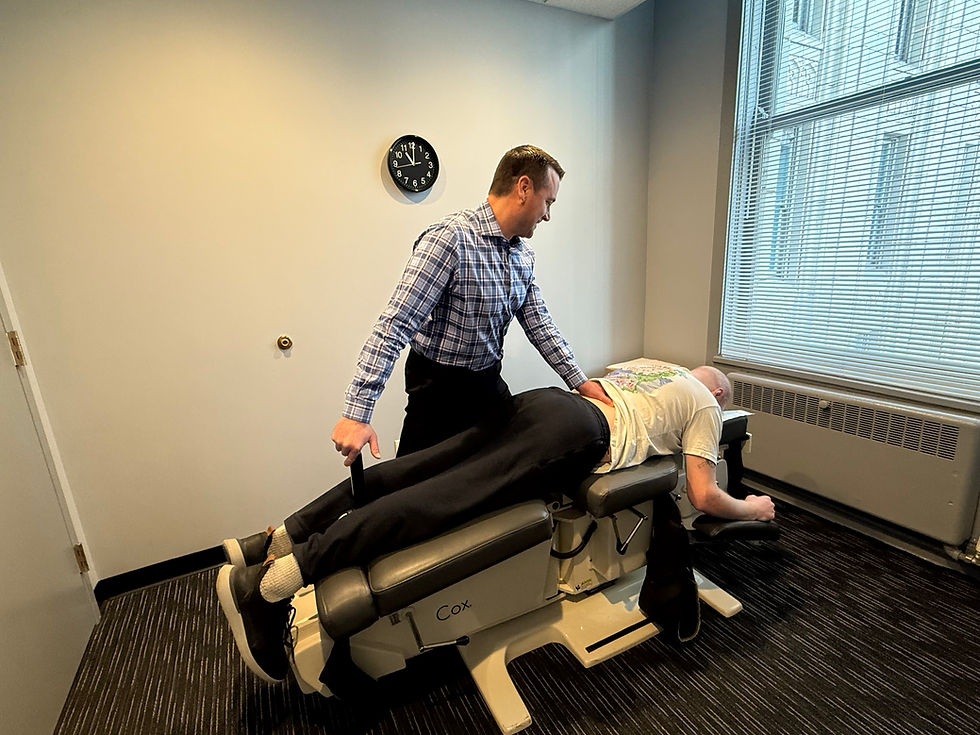
At Loop Spine & Sports Center, low back pain in working professionals is treated with a combination of approaches tailored to what the examination finds. The foundation of care for most patients is chiropractic adjusting to restore proper motion to the restricted lumbar and pelvic joints that are contributing to the pain. For patients with disc involvement, lumbar flexion distraction and spinal decompression therapy are added to address the disc directly.
Massage therapy is a central part of treatment for most low back pain patients here. The muscular component of desk-related low back pain is significant and often the primary driver of day-to-day discomfort. Deep tissue massage targeting the paraspinal muscles, hip flexors, glutes, and surrounding soft tissue addresses the soft tissue side of the problem in a way that chiropractic adjusting alone cannot fully resolve. Most low back pain patients receive both adjusting and massage on their regular visits and respond significantly better than with either approach alone.
For patients whose low back pain has a foot mechanics component, custom foot orthotics are sometimes part of the treatment plan. Overpronation and other foot imbalances create altered mechanics that travel up through the ankles, knees, and hips into the lumbar spine, and correcting those mechanics can make a meaningful difference in how well the spine responds to care and how long the results hold.
The Case for Maintenance Care
For Loop professionals, the conditions that cause low back pain do not go away when the initial course of treatment is complete. The job is still there. The commute is still there. The desk and the screen are still there. Many patients who work in the Loop find that periodic chiropractic care and massage on a maintenance basis, whether monthly or every few weeks depending on their situation, is the most effective way to stay ahead of the problem rather than waiting for it to become severe before coming back in.
That is always the patient's choice. There is no pressure and no preset maintenance program. But for people who sit for a living, the clinical reality after nearly 25 years of treating them is that staying on top of it consistently produces better long-term outcomes than treating it only when it becomes significant.
Located Steps From Your Office
Loop Spine & Sports Center is located at 30 N. Michigan Ave., Suite 605, at the corner of Michigan Avenue and Washington Street, directly across from Millennium Park. Whether you work on Michigan Avenue, in the Daley Center, in one of the federal buildings in the Loop, or anywhere else in the downtown core, we are likely within walking distance of your office.
Every CTA train line serves the Loop. For patients who drive, we offer parking validation at the Millennium Garages Grant Park North Garage at 25 N. Michigan Ave., steps from our front door, dropping the cost to just $14 for up to 12 hours.
New patients can take advantage of our $75 first visit special, which includes a thorough consultation, complete spinal examination, digital X-rays if needed, and a report of findings. Mention this offer when you call, text, or book online to receive the special rate. No pressure, no obligation. Just an honest conversation about what is going on and whether we can help.
Patients using insurance will be billed according to their plan's fee schedule. Copays, coinsurance, and deductible amounts may apply.