Cervicogenic Headaches: When Your Headache Is Actually a Neck Problem

Most people assume a headache starts in the head. Sometimes it does not. A cervicogenic headache is a headache that originates in the neck, and it is easy to mistake for a migraine or a tension headache. If you have a headache that seems to come with a stiff neck, gets worse with certain head movements, and keeps returning no matter what you take for it, the neck may be where the real problem is.
This post explains what cervicogenic headaches are, how they differ from other headaches, how they are evaluated, what the research says about care, and when a headache needs a physician instead. It builds on our broader post on what the research says about chiropractic care for headaches, with a closer look at this one type.

What Is a Cervicogenic Headache?
The International Classification of Headache Disorders (ICHD-3) defines a cervicogenic headache as a headache caused by a disorder of the cervical spine and its component bony, disc, and soft tissue elements. It is usually, but not always, accompanied by neck pain.
To diagnose it, the classification requires evidence of a neck disorder that is known to be able to cause headache, plus evidence that the neck is actually the cause. That evidence includes at least two of the following:
The headache developed in a time relationship with the onset of the neck problem
The headache improved or resolved in parallel with the neck problem
Reduced neck range of motion, with the headache made significantly worse by provocative movements
The headache was abolished after a diagnostic nerve block of a neck structure
The headache also must not be better explained by another headache diagnosis. In plain terms: the neck has to be shown to be involved, not just assumed.
What It Typically Feels Like
According to the same classification, typical features include pain that stays on one side of the head, pain provoked by pressure on the neck muscles or by head movement, and pain that spreads from the back of the head toward the front. Some people also have nausea or light and sound sensitivity, generally to a lesser degree than in migraine.
Patients often describe it as:
A one-sided ache that starts at the base of the skull and travels up toward the forehead or behind the eye
A headache that is worse after long periods at a screen or in one position
Neck stiffness or a reduced ability to turn the head fully
A headache that can be set off by a particular neck movement or by pressing on a tight spot in the neck
The classification is clear that these features are not unique to cervicogenic headache and do not prove the neck is the cause on their own. That is why a hands-on exam matters.
Why It Is So Easy to Miss
Cervicogenic headache overlaps with migraine and tension-type headache, and many people with a neck-related headache are told they have one of those instead. Two things add to the confusion. First, migraine-type symptoms can show up in a cervicogenic headache. Second, imaging of the upper neck often shows changes in people who have no headaches at all, so a scan alone cannot settle the question. The ICHD-3 itself notes that upper cervical imaging findings are common in people without headache and are suggestive, not conclusive.
The practical result is that the diagnosis rests on the history and the physical exam: what the headache does, what provokes it, and how the neck moves and responds to testing.
How It Is Evaluated
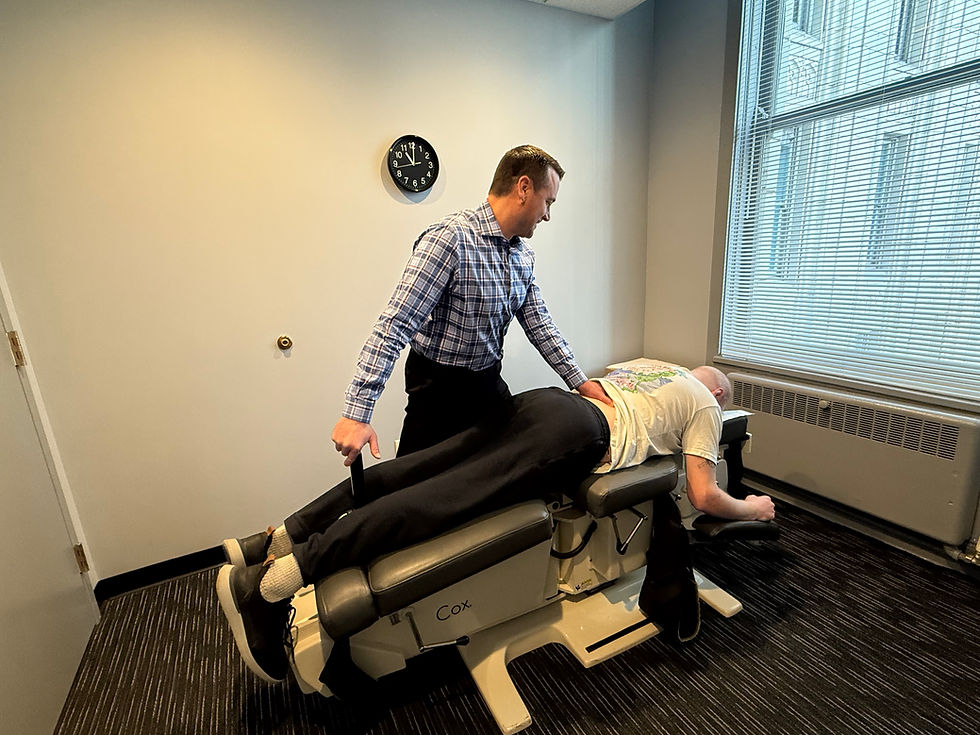
An evaluation at Loop Spine & Sports Center starts with your history: where the headache starts, which side, what makes it better or worse, how it relates to neck pain, and whether anything suggests a different cause. Then Dr. Trottier examines how your neck moves and how the joints and muscles respond to pressure and testing. You can read about his background on the Dr. Ron Trottier page.
One test used for this purpose is the cervical flexion-rotation test. With you lying on your back and your neck bent forward, the examiner turns your head to each side. This position concentrates rotation at the top two vertebrae, so a restricted or painful range can point to upper neck involvement. In one study of the test, normal rotation in this position averaged around 44 degrees to each side, and people with headache linked to the upper neck averaged roughly 17 degrees less. No single test is definitive, so the result is read alongside the rest of the exam.
Digital X-rays are taken only if needed. Some cases call for a medical workup first, and a diagnostic nerve block, the strictest way to confirm a neck source, is a medical procedure outside what we do.
What the Research Says About Care
The research on conservative care for cervicogenic headache is among the more encouraging in the headache field, though it has limits.
A multicenter randomized trial of 200 people with cervicogenic headache (Jull et al., Spine, 2002) compared manipulative therapy, a low-load exercise program, both together, and a control group. At 12 months, manipulative therapy and exercise each reduced headache frequency and intensity significantly, with benefits maintained. Combining them was not significantly better than either alone.
The 2011 chiropractic headache guideline recommended spinal manipulation, joint mobilization, and deep neck flexor exercises for cervicogenic headache, rating the evidence as moderate.
A 2025 network meta-analysis of 14 studies and 1,297 patients ranked cervical spine manipulation highest for short-term pain and disability, and found that a specific mobilization technique improved pain and function. The authors also noted that clinician expertise appears to matter.
Those results do not mean every neck-related headache resolves with chiropractic care. Studies vary in quality, and benefits differ from person to person. They do suggest that when the neck is the source, careful manual care and targeted exercise are reasonable options.
What Care Can Look Like
When the exam points to the neck, care may include chiropractic adjustments chosen to fit your case, including gentler techniques where appropriate, plus massage therapy for tight neck and shoulder muscles and modalities such as electrical stimulation therapy or therapeutic ultrasound to help calm irritated tissue. We also look at the daily habits that keep the problem going.
The research supports targeted exercise, and we should be clear about our scope. We do not offer physical therapy or a rehab exercise program. When a structured exercise program is what you need, we will point you to a physical therapist.
Every plan has a purpose and a review point. If you are improving, care continues or tapers. If you are not improving as expected, the plan changes, we reconsider the diagnosis, or you are referred. Our post on what changes after treating thousands of patients explains how that judgment develops.
If You Work at a Desk
Many of the neck-related headaches we see in the Loop go with long hours at a screen. Sustained positions load the upper neck, and a workstation that was never set up for you adds to it. We cannot say posture alone causes a cervicogenic headache, but reducing the strain often helps.
Breaking up long stretches of sitting, bringing your screen up to eye level, and avoiding long periods with your head pushed forward are sensible places to start. Our posts on the connection between desk work and back and neck pain and the Chicago Loop worker's guide to low back pain go into more detail, and our neck pain and upper back pain pages cover related problems.
When a Headache Needs a Doctor First
Some headaches should not be handled in a chiropractor's office first. Seek urgent medical attention for:
A sudden, severe "worst headache of your life"
Headache with fever, stiff neck, confusion, or a rash
Headache after a head or neck injury
Headache with weakness, numbness, vision changes, slurred speech, trouble walking, or sudden dizziness
A new headache pattern after age 50, or headaches that keep getting steadily worse
Neck pain and headache can also be early signs of a tear in a neck artery, which is rare but serious. A population study in Spine found that visits for headache and neck pain were strongly associated with later vertebrobasilar stroke, and the authors concluded this likely reflects people with a dissection already underway seeking care for early symptoms, not harm caused by care.
That is exactly why a proper history comes first, and why we choose techniques carefully. Our post on red flags in chiropractic care covers more warning signs, and our headaches page explains the types we see.
What to Expect From a First Visit
Expect a full history, a hands-on exam of your neck and upper back, a plain explanation of what we find, and a plan that includes how we will know whether it is working. If you have never visited a chiropractor, our post on what to expect at your first chiropractic appointment walks through it.
If you are comparing providers, our guide on how to choose the best Chicago chiropractor lists what to check, and our post on the Certified Chiropractic Sports Injury Physician credential explains Dr. Trottier's post-graduate training. You can also review our frequently asked questions or contact the office before booking.
Sources
International Headache Society. ICHD-3, 11.2.1 Cervicogenic headache.
Jull G, et al. A randomized controlled trial of exercise and manipulative therapy for cervicogenic headache. Spine. 2002;27(17):1835-1843.
Ogince M, et al. The diagnostic validity of the cervical flexion-rotation test in C1/2-related cervicogenic headache. Man Ther. 2007.
Bryans R, et al. Evidence-based guidelines for the chiropractic treatment of adults with headache. J Manipulative Physiol Ther. 2011;34(5):274-289.
Xu X, Ling Y. Spinal manipulation, mobilization, massage, and exercise for cervicogenic headache: a systematic review and network meta-analysis. Front Neurol. 2025;16.
Cassidy JD, et al. Risk of vertebrobasilar stroke and chiropractic care. Spine. 2008;33(4 Suppl):S176-S183.
Ready to Get Evaluated?
If your headaches seem tied to your neck, an evaluation can tell you whether that is the case and whether chiropractic care is a good fit or you should see a physician first.
New patients can take advantage of our $75 first visit special, which includes a thorough consultation, complete spinal examination, digital X-rays if needed, and a report of findings.
Mention this offer when you call, text, or book online to receive the special rate. No pressure, no obligation. Just an honest conversation about what is going on and whether we can help.
Patients using insurance will be billed according to their plan's fee schedule. Copays, coinsurance, and deductible amounts may apply.